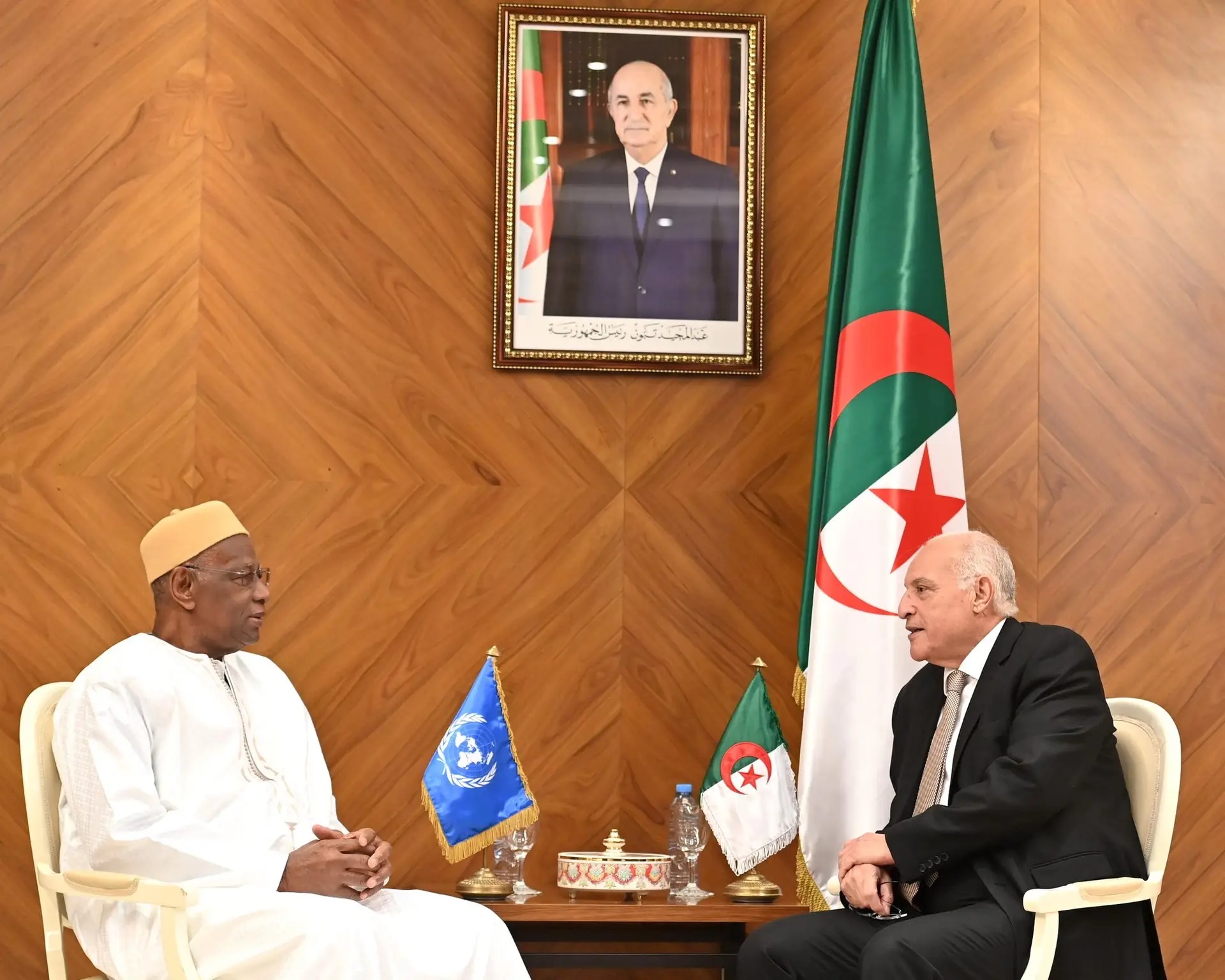
In a statement to the press at the end of the meeting, Attaf expressed Algeria's support for the ongoing efforts of the UN envoy to end the Libyan crisis and enable the country to regain its place and its role in the various regional and international arenas to which it belongs, praising his ongoing coordination with Algeria.
The Minister SAID that "the rich and in-depth discussions he had with Abdoulaye Bathily made it possible to stress that the international and regional context, overwhelmed by conflicts, crises and tensions, must not make us forget that the brotherly Libyan people still need the support of the international community to meet the challenges imposed by the current period and unite their ranks to put an end to the crisis."
He reiterated that Algeria, which has always stood by Libya "by word and deed, reaffirms today that it will remain faithful to its policy and its position on the crisis that threatens the security, stability and unity of this brotherly neighbouring country, and will continue to give its full support and commitment to the efforts being made by both the UN and the African Union (AU)."
Attaf welcomed the efforts made under the aegis of the two organisations, stressing that the UN and African processes "are interdependent in their approach, complementary in their aims, and support each other in achieving the ultimate objective of putting an end to the crisis, turning the page on divisions and restoring cohesion" between Libyans.
In this respect, he felt that the electoral process, for which the UN is working to bring together the legal and political conditions necessary for its success as a permanent and lasting solution to the Libyan crisis, also needs a process of national reconciliation, which the AU is working to promote as a consensual platform bringing Libyans together, "within the framework of a comprehensive and inclusive national project, far from any tug-of-war and divisions, and far from the law of the strongest."
According to Attaf, the consultations were "a valuable opportunity to find out about the progress made in these two processes, supported directly by Algeria through the use of its experience and resources for the benefit of the Libyan brothers, and indirectly through the UN and the AU, in particular the high-level African Commission, of which Algeria is an active member".
The Minister of Foreign Affairs said that he and the UN envoy had welcomed the "fruitful" efforts made to adopt the legislation needed to oversee the electoral process in Libya, and to overcome the disputes that are hampering this process, as well as the meetings organised by the AU with the participation of the various Libyan political factions, as a prelude to the holding of an important national reconciliation conference.
For Attaf, "the Libyan crisis had no reason to exist, except because there was foreign military intervention, just as it should not have been prolonged, He reiterated Algeria's total rejection of all forms of intervention in Libya, whether political or military, and called for an end to it.
In the same vein, Attaf stressed "the imperative need to deal with this issue as a matter of priority, by referring to the relevant decisions adopted by the Security Council, and by respecting the commitments made at the various international conferences, in particular Berlin Conferences 1 and 2".
For his part, Bathily said that "the United Nations needs Algeria's experience to help the Libyans overcome the crisis they have been going through for several years now, because Algeria plays an important role in resolving the crisis", adding that "Algeria's experience in national reconciliation and its position as a member of the African Union panel could be of great use".
The UN official also stressed the importance of holding elections in Libya in order to provide the country with legitimate institutions, pointing out that the political fragmentation that Libya is currently experiencing "is having negative repercussions not only on peace in Libya, but also on peace and stability in neighbouring countries and in the Sahel region."
For the UN envoy, seeking "peace for the crisis in Libya means seeking peace and stability for the entire region."